Friendship test: do you two tell the same story?
For fun and reflection, not a psychological assessment or professional advice.
How it works
- Send your friend a link, or play on one phone if they’re next to you. There’s no app and no sign-up.
- Every card asks who: who says “I don’t mind” and very much minds? You each swipe or tap Me or Them. There’s no “both”.
- Halfway, you each place one bet, such as how many cards you’ll settle. No changing it.
- Your friend answers the same cards without seeing yours.
- Count to three. The fingers come out on your most divided cards. The last card can still turn the verdict, and it can decide the bet.
Friendship test, BFF test or friendship quiz: which is this?
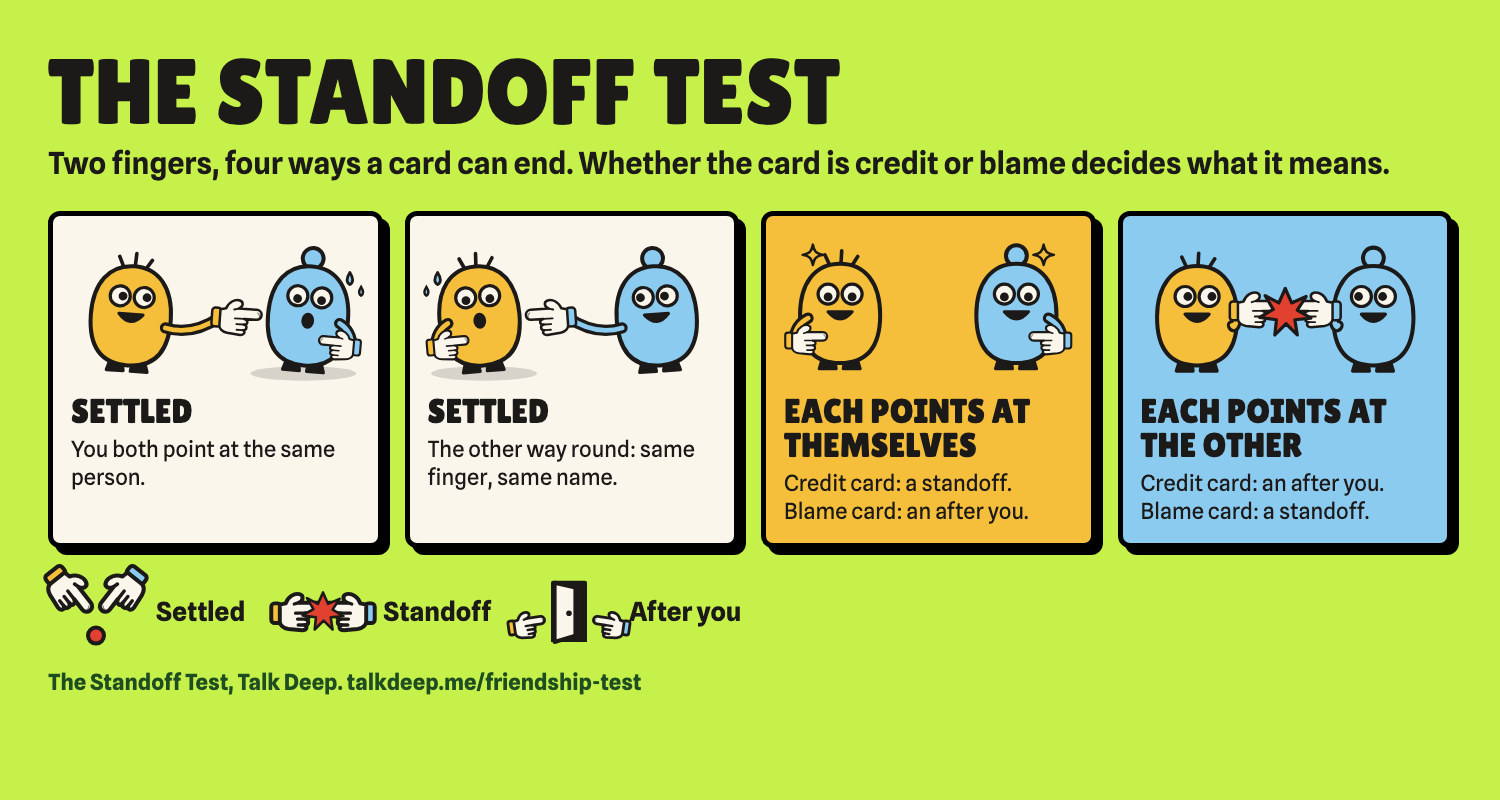
The Standoff Test: four ways a card can end
Settled
You both point at the same person. On the record, and nobody argues.
Settled
The other way round: same finger, same name. It’s your count, nothing more.
Each points at themselves
On a credit card, that’s a standoff: two heroes. On a blame card, it’s an after you: you each own up.
Each points at the other
On a credit card, that’s an after you: you each give it away. On a blame card, it’s a standoff: it was them.
The Standoff Test: two fingers, four ways a card can end. Copy it, draw it on a napkin, play it in the pub. Teaching this, or writing about friendship? Use the diagram and link to this section. Please credit it as “The Standoff Test, Talk Deep”.
What a result looks like
You don’t get a percentage or a friendship score. You get the cards where your stories split, a joke verdict, who called the bet, and something to talk about. Every line comes from your own fingers, and it tells you the count it rests on. Whatever you leave open stays open: next time, you can reopen just those cards.
Sam carries. Alex gets carried.
You both gave Sam the credit on 3 cards, and Alex on none.
Who’s holding a screenshot that could end the other?
Sam says Alex. Alex says Sam.
Standoff. Don’t show it. Just describe it.
The bet: Sam called it. Alex didn’t. Sam bet you’d settle more than half, and you settled 7 of 12.
An example made up for this page. Your names, your cards.
Friendship test questions: 42 to ask each other
Small crimes
13- Who has said “five minutes away” from their own bed?
- Who’s holding a screenshot that could end the other?
- Who says “I don’t mind” and very much minds?
- Who’d get you both asked to leave a wedding?
- Who starts sentences with “don’t be mad, but”?
- Who has told the other’s story as their own?
- Who has something of the other’s and is hoping it’s forgotten?
- Who would sell the other out for a free dessert?
- Who says “one more” and has never meant it?
- Who eats the last slice, then asks who ate it?
- Who’d crack first if you were both questioned?
- Who has a nemesis the other has to hate on principle?
- Who’d read the other’s diary, then correct the spelling?
Who does the work
13- Who remembers the birthday without a phone telling them?
- Who has done more for this friendship this year?
- Who keeps score, even a little?
- Who turns “we should” into an actual date?
- Who owes the other a proper “how are you, really”?
- Who breaks a month of silence with a meme and no explanation?
- Who says sorry first, even when it was clearly the other one?
- Who decided you two were friends before the other had a say?
- Whose “something came up” was actually the sofa?
- Who vanishes for weeks, then opens with “hey stranger”?
- Who sits through a story they’ve heard four times, and still laughs?
- Who sends the “are you alive” text?
- Who remembers how you actually met, word for word?
The soft part
12- Who’d notice first if the other was pretending to be fine?
- Who hides it better when they’re not okay?
- Who’d get on a night train without asking why?
- Who has leaned on the other more?
- Who changed the other’s life more?
- Who’d take it harder if the other moved abroad?
- Who tells the truth when nobody else will?
- Who’s worse at goodbyes?
- Who needs a hug and won’t say so?
- Who believed in the other before they believed it themselves?
- Who’s prouder of the other than they let on?
- Who still hasn’t said the thing they should have said?
The last card
4- Who got the better deal, ending up with the other?
- Who’d be more lost without the other?
- Who’d cry first giving a speech about the other?
- Who needs this friendship more?
How good a friend are you? If you’re on your own
That’s a count, not a grade. Pick one you left blank and do it this week.
Why you answer apart
That’s not a reason to worry about yours. It’s the reason a friendship test works better with two people answering than with one person guessing alone. You can only find out how your friend sees it by asking, and answering apart keeps you both honest.
How to tell if someone is a good friend
No quiz can tell you this, and be wary of one that says it can. What you can do is look at what they do. These are the questions we’d ask, and they’re about habits rather than a score.
- Do you feel better or worse after seeing them?
- Do they ask how the big thing went, the day after?
- Can you tell them something hard, and can they tell you?
- If you went quiet for a while, would they notice?
- Does the effort go both ways over time, even if it’s never equal in any one month?
- Can you disagree and still make plans for next week?
What makes a strong friendship
That’s why the middle of this test asks who does the work. Nobody keeps a perfect balance, but it’s good to know whether you both see the same one.
Other friendship tests you may have heard of
People have been testing friendships for a long time, mostly as thought experiments. You take these on your own, about someone else. Ours takes two.
- Two beers and a puppy. Author Ross McCammon’s test asks two things: would you have two beers with this person, and would you let them look after your puppy for a weekend? It separates people who are fun from people you trust.
- The airport test. An idea that goes round online: who would you call to pick you up from the airport, and who would actually come?
- Aristotle’s three friendships. In Nicomachean Ethics, Book VIII, Aristotle sorts friendships by what holds them together: usefulness, pleasure or goodness. It’s the oldest friendship test we know of, and it has no scoreboard.
Make a friendship test and send it
To test your friends from far away, choose Send a link, answer your cards, and send it however you normally talk. Your friend answers on their own phone when they’re free, with no app and no account, and you both see the result. Your first name and answers are kept for 30 days so you can compare, then deleted. If our server can’t be reached, the answers travel inside the link itself and aren’t stored.
A friendship question game with no phones
- Who has said “five minutes away” from their own bed?Who’d get you both asked to leave a wedding?Who would sell the other out for a free dessert?Who goes back for their phone in the horror film?Who turns “we should” into an actual date?Who remembers the birthday without a phone telling them?Who vanishes for weeks, then opens with “hey stranger”?Who decided you two were friends before the other had a say?Who’s worse at goodbyes?Who tells the truth when nobody else will?Who’s prouder of the other than they let on?Who’d be more lost without the other?
How we built this
Questions people ask
What is a friendship test?
A set of questions two friends answer about their friendship. In this one you each point at one of you on every card, apart, then compare. You see where your stories match and where they don’t.
Can a friendship test tell me if someone is a real friend?
No, and be wary of any quiz that says it can. This one is for fun and reflection. It can show you how each of you sees the friendship, and give you good things to talk about.
What’s a good score?
There isn’t one to aim for. You see how many cards you settled, how many ended in a standoff and how many in an after you. An after you, where you each give the credit away or take the blame, is worth more than any number.
What’s the bet for?
Halfway through you each bet on how the round will end, for example whether you’ll settle more than half the cards. The showdown pays it, and if you play again with the same friend on this phone it keeps the tally of who called it.
Can I take it on my own?
It needs two people, because the point is to see whether two stories match. Send it to a friend and answer your side now. If you’d rather think on your own first, use the short self-check on this page.
Is this the novel The Friendship Test?
No. Elizabeth Noble’s novel The Friendship Test, published in the UK as The Tenko Club, is about four women who meet at university. This page is a free game for two friends, and has nothing to do with the book.
Why is there no “both” answer?
Because “both” is where every good argument goes to die. Having to pick one name is what makes the game. If it’s honestly a tie, point anyway and defend it afterwards.
What’s the difference between a friendship test and a BFF test?
Our BFF test asks how well you know your friend: one answers, the other guesses. This friendship test asks how you each see the friendship, and nobody can get a question wrong.
How do I test my friends?
Choose Send a link, answer your cards and send it. Each friend who answers gets their own result with you. To rank a whole group on one quiz, use the best friend quiz.
Is this a friendship quiz I can play with no phone?
Yes. Read the questions out, count to three and point at the same moment. The printable cards on this page are made for it.
Do we need the app or an account?
No. It’s free and it plays in your browser, on one phone or with a link. On one phone, nothing leaves the phone.
Can more than two people play?
One round is for two people. To compare with someone else, finish and choose Try it with someone else. For a whole group, try the best friend quiz, where everyone answers one link and lands on a scoreboard.
More games


